Every day spent on manual, low-quality prospecting is a day your competitors are using to capture the market. That is because Marketing, Sales, and Success are playing three different games because they are looking at three different sets of data. The result is a fragmented customer experience that kills retention. That is where a reliable b2b software comes handy, to empower you with the ability to look around the corner with literal sensors that give you that “pre-cognitive” advantage in the marketplace.
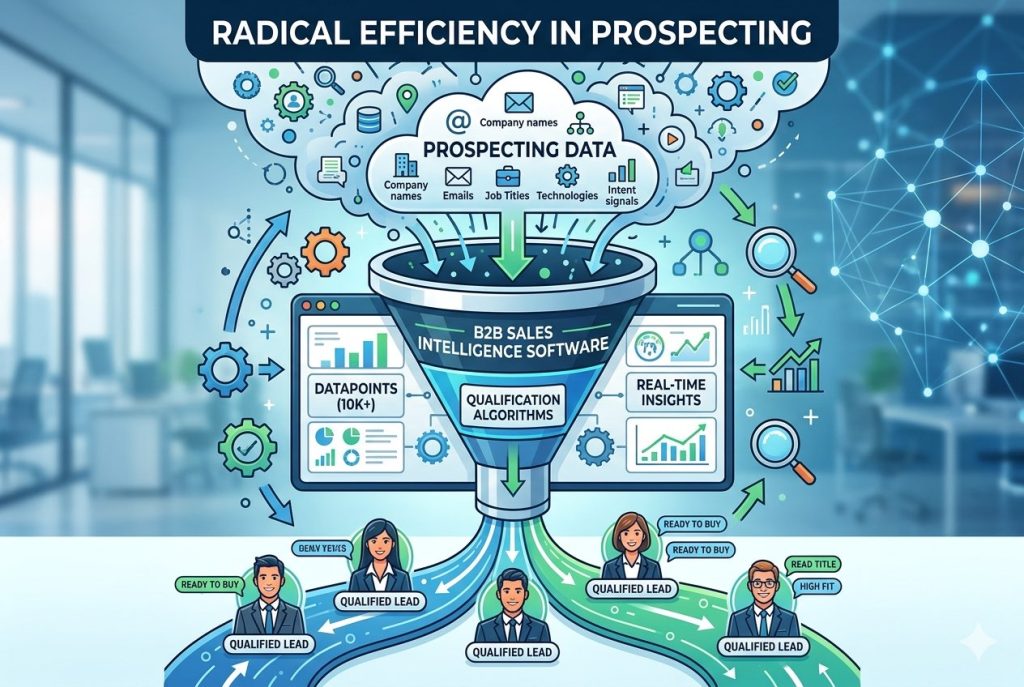
1. Automated Discovery: Unlocking High-Value Targets Instantly
The old model of manual research is slow, fragmented, and often outdated. Teams chase signals that vanish before they can act. However, a reliable b2b sales intelligence software change the game by infusing precision in filtering your prospects so that you can largely interact with those who are predisposed to buy.
It’s no more about volume-based revenue draining strategy where you reach out to everyone.
a) Real-time data aggregation: Ensures the screen is never showing you a “stale” image. It is the mechanism that transforms your CRM from a static database of yesterday’s contacts into a live, pulsing stream of market activity by extracting relevant insights from social activity, company news, funding events, and digital footprints.
b) Instant profiling: Instead of spending 30 to 60 minutes researching an account on LinkedIn, company websites, and industry news before they feel “ready” to reach out, the tech behind profiling replaces this manual work with a machine-speed summary.
c) Opportunity surfacing: High-potential accounts are highlighted immediately, cutting wasted cycles.
This is more than speed—it’s strategic precision at scale. Teams operate with clarity, executives gain visibility into the real opportunity landscape, and research becomes a high-value, decision-ready activity rather than a tedious chore.
2. Precision Targeting: Engaging Prospects When They’re Ready
Randomized outreach is a relic of the past. Modern sales intelligence software leverages intent-based interception. That represents a shift from randomly pushing a message out to intercepting the buyer where and when they are already looking. That means teams can intercept prospects who are actively researching solutions, targeting those genuinely “in-market.”
Systems may optimize on early intent signals that reveal readiness before competitors even notice. That may include job postings, funding announcements, or website activity.
a) Behavioral insights: Helps see the invisible journey. Hence, you aren’t guessing if they are interested; the data proves they are.
b) Contextual prioritization: Not all leads are created equal. The system helps identify the “sweet spot”, the highest probability of closing.
c) Strategic alignment: A system that respects journey-aware messaging can distinguish between an entry level client and a person comparing competitors, and acts accordingly.
This transforms prospecting into a precision operation. Teams stop gambling on leads and start hunting with intent. Engagement becomes tactical, conversion rates improve, wasted cycles disappear, and reps act as specialists executing a well-calibrated strategy.
3. Structured Lead Scoring: Converting Intelligence into Actionable Priority
In a high-velocity environment, treating all prospects as equal is a recipe for “Revenue Drift.” Structured Lead Scoring acts as the analytical filter of your Revenue Intelligence Architecture, ensuring your most expensive resources—your people—are always deployed against the highest-probability outcomes.
a) Multidimensional Automated Scoring: Instead of subjective “gut-feel” rankings, leads are objectively weighted by Firmographic Fit (ICP alignment), Behavioral Engagement (content consumption), and Buying Intent (real-time signals like job postings or funding).
b) Dynamic Intelligence Updates: Static scores are a liability. By leveraging Historical Benchmarking, the system adjusts rankings in real-time as market conditions shift or prospects exhibit “Anomaly Detection” patterns, such as a sudden surge in website activity.
c) Surgical Resource Alignment: This creates a disciplined Revenue Continuum. High-probability “Hot” leads trigger immediate executive intervention, while lower-scoring prospects flow into automated, contextually-aligned nurture streams.
That way, you move from reactive chasing to mathematical predictability. By simplifying your focus, you transform the pipeline from a cluttered list into a strategic hierarchy.
4. Actionable Insights: Converting Intelligence into Execution
Instead of following the market, you lead it. A reliable platform detects emerging shifts—like a sudden surge in demand within a specific vertical—allowing you to pivot your messaging before a countering wind blows.
a) Scenario Modeling: You gain a Strategic Sandbox. Before launching a new campaign, you can “test” different pricing or targeting strategies against historical data to forecast the most likely revenue outcome without real-world risk.
b) Precision Coaching: Data drives Team Optimization. By analyzing exactly which outreach patterns and talk tracks result in closed deals, leadership can provide surgical, evidence-based training that elevates the entire team’s performance.
This shift transforms your sales department from a “guessing game” into a Precision Growth Engine.
In essence, B2B intelligence is not optional—it’s transformative. Automating discovery, targeting prospects with surgical precision, scoring leads intelligently, and acting on insights allows organizations to achieve radical efficiency, converting lead qualification from chaotic guesswork into a disciplined, scalable, high-performing growth engine.